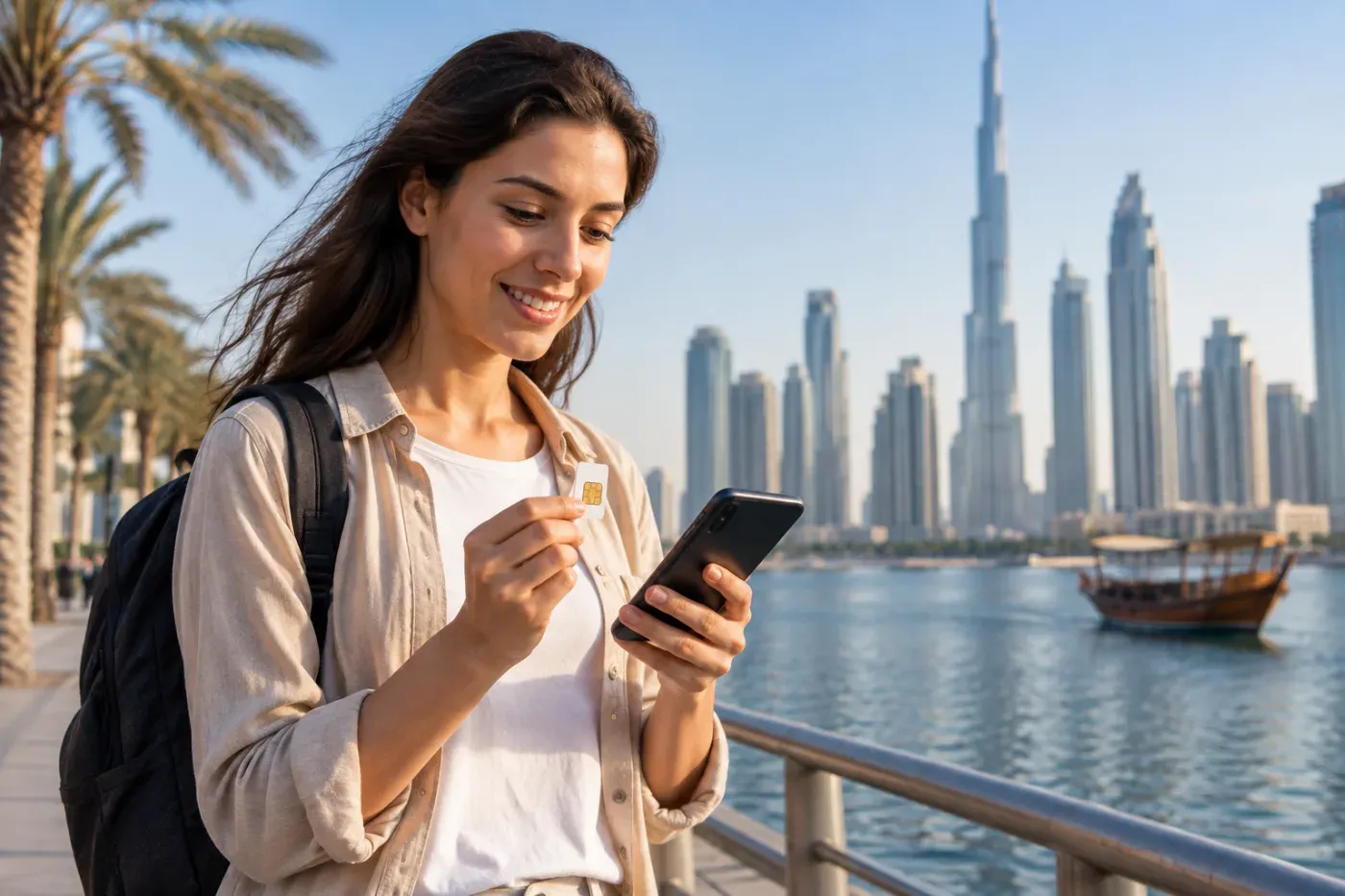
SIM Card Guide
Du and Etisalat tourist SIMs, AED 55–100 for 2–10GB. Buy at the airport or any mall. eSIM options. Passport only needed.
Du vs Etisalat vs eSIM
Two networks run the country: Etisalat (e&) with marginally wider coverage into deserts and highways, and du with aggressive tourist bundles and slicker app experience. In cities they are indistinguishable — pick on price. Tourist packs cluster around AED 55–100 for 2–10GB valid 7–28 days, sold at airport counters, mall kiosks and carrier stores with passport registration taking minutes. Both throw in international minutes that cover hotel and tour-operator calls.
eSIM travellers can skip the counter entirely: Airalo, Holafly and carrier eSIMs activate before landing, though per-gigabyte costs run higher than local SIMs for heavy users. Dual-SIM phones run the obvious winning combo — home eSIM kept alive for banking two-factor codes plus a local SIM for data. Whatever the format, test maps and WhatsApp before leaving the terminal; fixes take minutes there and hours later.
Coverage, speed and limits
Urban 5G is excellent and widespread; highways hold LTE; deep desert, Liwa dunes and mountain wadis drop to patchy or nothing — download offline maps for any self-driven desert or Hatta day. Hotel and mall WiFi fills gaps indoors, and the free WiFi across metro stations, beaches and parks covers light use. Speeds comfortably handle video calls, navigation and uploads everywhere signal exists.
Fair-use throttling can touch the cheapest tourist packs after heavy hotspot use — read the data cap, not just the headline gigabytes. Topping up runs through carrier apps with international cards accepted, and validity extensions cost less than new packs. Keep the SIM active until departure day; number recycling is aggressive and OTP access dies with it.
Hotspots and second devices
Phone hotspot mode turns one tourist SIM into whole-group connectivity: tablets, laptops and travel companions share the data pool without extra packs. The cost is battery (hotspotting drains 1% every few minutes) plus fair-use scrutiny on unlimited-marketed packs — heavy laptop tethering trips throttling fastest. For groups, one high-data SIM hotspotting plus individual basic packs beats five premium packs on price.
Tablets and spare phones accept the same tourist SIMs, and portable WiFi hotspot devices (rented at the airport or from carrier stores) serve groups of 4+ with dedicated batteries. Whatever the setup, name the hotspot clearly, password it strongly, and switch it off in crowds — open hotspots attract freeloaders and security attention alike.
Connectivity checklist
- Buy at the airport counter (passport only) or activate an eSIM before landing.
- Compare data caps and validity, not just headline prices.
- Test maps, WhatsApp and banking codes before leaving arrivals.
- Download offline maps for desert, Hatta and mountain days.
- Top up via carrier apps; keep the SIM alive until departure.
❓ Common questions
Which is better, du or Etisalat?
Near-identical in cities; Etisalat edges remote coverage, du edges tourist pricing. Choose by deal.
Can I keep my home number active?
Yes with dual-SIM or eSIM: local SIM for data, home line on WiFi/minimal roaming for OTP codes.
Is there free WiFi?
Across malls, metro, hotels, cafés and many beaches — fast and genuinely useful, though a SIM remains essential outdoors.
How much data do I need?
Two to three gigabytes per week for maps and messaging; 10GB+ for hotspotting, uploads and video calls.
What ID do I need?
Passport only for tourist packs. Registration is legally required and takes minutes at any counter.
Still have questions about this?
Our Dubai-based team answers on WhatsApp in ~5 minutes, 24/7.